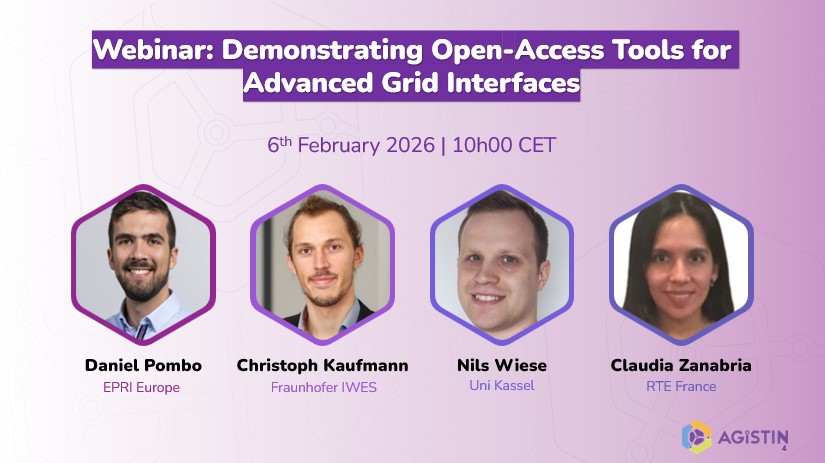
The AGISTIN project is driving innovation in energy storage integration, making it smarter, more efficient, and cost-effective. The project is organising a two-hour webinar on the 6th of February 2026, offering academics, researchers and professionals interested in modelling and tools a unique opportunity to explore our work through real-world use cases and hands-on simulations.
In this webinar you’ll gain practical insights into how Advanced Grid Interfaces (AGI) and grid-forming technologies (GFM) can enable flexible, resilient energy systems, critical for integrating renewables, hydrogen production, and other emerging technologies. By exploring scenarios such as RoCoF events, islanding, and active power response, you’ll see how AGISTIN’s approach reduces hardware costs, improves system stability, and accelerates the energy transition.
You can register to the webinar here.
All models and tools showcased during the webinar will be freely made available through the project’s GitHub repository. For a further deep dive into the models, please check the open deliverable D3.2 Open‑source simulation models of the pertinent grid coupling systems, open for parametrisation according to individual load, generation, and storage technologies.
Date: February 6th 2026, 10h00-12h00 CET
Agenda
- Project Overview and Introductions to Tools and Models, Daniel Pombo (EPRI Europe)
- Demonstrations
- Use Case #1: AC-AGI improving Green Hydrogen Production in Reduced Grid Connections– Christoph Kaufmann (Fraunhofer IWES)
- Use Case #2 Introducing AC AGI with asymmetric inertia – Nils Wiese (Uni Kassel)
- Use Case #3 Compliance of ACGI with grid forming requirements- Claudia Zanabria (RTE)
- AGISTIN Applications wrap up – Daniel Pombo, EPRI Europe
- Q&A
- Closing
Speakers
Nils Wiese works as a research associate at the University of Kassel and Fraunhofer IEE. He is focusing on modelling inverters and their grid integration. In the context of AGISTIN he is leading the activities of generic models and benchmarking the AGI options. Different models and controls are taken into account and benchmarked against relevant grid code requirements.
Christoph Kaufmann is a research associate at the Fraunhofer Institute for Wind Energy Systems IWES in Hamburg, focusing on modelling and grid stability assessment including the grid integration of electrolysers, while pursuing a PhD in Electrical Engineering. In the AGISTIN project, he is leading the activities of the Fraunhofer IWES with a focus on the use case of green hydrogen, which includes a power hardware-in-the-loop demonstration.
Claudia Zanabria received her PhD in 2018. Since 2023, she has been working in the R&D department of the French transmission system operator (RTE), where she focuses on power system stability. Her research centers on the behavior of electrical systems increasingly dominated by power electronics. She is also actively involved in ENTSO-E working groups dedicated to grid-forming converters. Within the AGISTIN project, she contributes to RTE’s development of grid codes for AGI systems, both AC and DC.
Daniel Pombo works with EPRI Europe on R&D of hybrid power plants and future energy systems. His work focuses on coordinating wind, solar, storage, hydrogen, and conventional assets to advance grid decarbonization. His interests include power systems, control, optimization, and global collaboration from research to field demonstration. In the AGISTIN project, Daniel acts as Technical Manager by facilitating cross work package coordination across the consortium and surveying the scientific quality of all deliverables and outputs.