
As renewable energy deployment accelerates, grids worldwide face a structural shift: traditional synchronous generators are disappearing, while power electronics and variable renewables multiply. Ensuring system stability in this new reality requires new tools, new paradigms, and new forms of collaboration.
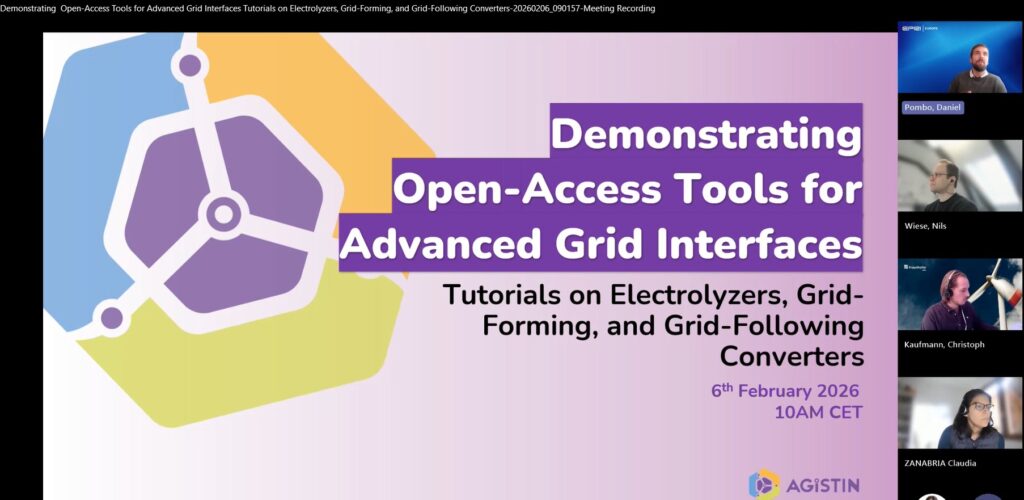
This AGISTIN project latest webinar Demonstrating Open-Access Tools for Advanced Grid Interfaces: Tutorials on Electrolyzers, Grid-Forming and Grid-Following Inverters (6th February 2026) brought together experts from EPRI Europe, Fraunhofer IWES, RTE, and the University of Kassel to showcase practical, open‑source modelling tools and testing methodologies designed to support the next generation of grid‑integrated storage and hybrid plants. Over the two-hour session, speakers demonstrated how electrolyzers, supercapacitors, and grid-forming converters can interact to provide stability services even under weak-grid conditions.
Why Advanced Grid Interfaces Matter
Daniel Pombo (EPRI Europe) opened the session by highlighting a core challenge: renewables, storage, and industrial loads (like electrolyzers) are increasingly co-located, but not yet seamlessly interoperable. Advanced Grid Interfaces (AGIs) aim to fix that.
AGIs are the “plug-and-play” layer that coordinates hybrid assets, enabling:
- reduced curtailment and higher renewable utilisation;
- new flexibility services such as grid-forming and frequency support;
- better plant‑level optimisation through integrated controls;
- more interoperable demonstration sites and real‑world testbeds.
These models and simulation tools are published openly on the project’s GitHub repository, supporting researchers, system operators, developers, and educators.
Electrolyzers in Weak Grids: Stability Under Stress
Fraunhofer IWES researcher Christoph Kaufmann presented simulation results from a 50 kW green hydrogen plant combining PV and an electrolyzer. The study analysed how the system behaves under progressively weaker grid conditions (using Short Circuit Ratio metrics) and explored whether grid-forming energy storage can support stable operation.
Key finding:
- Standard grid-following converters struggle below SCR~1
- Adding a grid-forming supercapacitor enables stable operation even at SCR 0.5
The open-access electrolyzer model included a physics-based representation of cell dynamics, enabling realistic assessment of transient responses, voltage control, and dynamic constraints. This model, already available publicly, allows users to scale electrolyzer size and experiment with converter behaviour under a range of grid strength conditions.
From Theory to Regulation: Validating Grid-Forming Performance
RTE’s Claudia Zanabria provided a rare deep dive into how Transmission System Operators evaluate and certify grid‑forming units. With Europe preparing the new RfG V2 network code, which will mandate grid‑forming functionality for larger storage systems, RTE is already running its own consultation and publishing detailed requirements.
In the webinar, Zanabria demonstrated how the AGI’s grid-forming supercapacitor is validated against RTE’s proposed test envelopes, covering:
- phase jumps
- SCR changes
- frequency events (RoCoF support)
- voltage amplitude variations
More than 200 tests are typically required for certification. Early results show that the AGI supercapacitor passes all fundamental tests presented, reinforcing the feasibility of grid-forming behaviour in hybrid environments.
Asymmetric Inertia: A New Way to Share Stability Duties
Nils Wiese (University of Kassel) introduced “asymmetric inertia”, a next‑generation control approach that lets different assets contribute inertia only in directions aligned with their physical constraints.
Examples:
- PV or wind inverters can offer inertia for rising frequency but not falling (as they cannot increase power beyond available resource);
- Vehicle chargers or electrolyzers can support falling frequency by reducing consumption, but cannot increase it;
- Batteries can support both directions, but must honour current limits and degradation considerations
This flexible control principle allows hybrid systems to share stability duties without oversizing hardware or violating device limits.
Looking Ahead
The AGI open-access toolbox continues to grow. Upcoming additions include automated compliance testing scripts, advanced grid-forming controls, and battery ageing models. The project’s demonstrators, from irrigation networks in Spain to green hydrogen site in the Netherlands, will soon publish real test results.
This webinar demonstrated not only technical capability, but also a commitment to open science and transparent collaboration. As grids become more renewable and more digital, these shared tools will play an essential role in shaping the resilient, interoperable power systems of the future.